
The non-toxic skincare movement has reshaped how millions of people shop for serums, foundations, and moisturizers. But alongside that positive shift, a wave of misinformation has muddied the waters. Terms like "clean," "natural," and "non-toxic" appear on countless labels, yet few consumers understand what they actually mean or, more importantly, what they do not mean. In this guide we break down seven of the most common non-toxic skincare misconceptions, explain the science behind each, and share practical steps you can take to build a routine that is both safe and effective. Whether you are exploring science-backed skincare products for the first time or refining a routine you already love, clarity starts here.
Myth 1: "Natural" Always Means Safer
This is one of the most persistent misconceptions in skincare. Many shoppers assume that if an ingredient comes from a plant, it must be gentle. In reality, natural ingredients can be irritating or allergenic for some skin types. Poison ivy is natural, but no one would call it a good skincare ingredient.
According to the Environmental Working Group, some natural ingredients such as certain clays may be contaminated with toxic heavy metals, and some essential oils are potent sensitizing allergens. The lesson is simple: always evaluate ingredients individually rather than trusting a single word on the label.
At Forever Bloom, every formula goes through rigorous testing. Our mission is to offer safer alternatives supported by actual scientific research, not marketing buzzwords.
Myth 2: "Non-Toxic" Has an Official Definition
Non-toxic is a marketing term, not a regulated standard. The FDA has never established a legal definition for the phrase in the personal care industry. As the EWG notes, scientifically speaking nothing is truly nontoxic because even water in large doses can be harmful.
Greenwashing is the practice of making misleading environmental or safety claims to attract conscious consumers. It thrives precisely because terms like "non-toxic," "clean," and "natural" lack enforceable standards. Your best defense is ingredient literacy. Visit our Learn the Truth page where Forever Bloom scientists answer real consumer questions about what ingredients actually do.
Myth 3: Preservatives Are Always Harmful
Preservatives are ingredients added to skincare products to prevent bacterial and fungal growth. Without them, your favorite serum could become a breeding ground for microbes in days. Fear of preservatives often stems from concerns about parabens, yet many studies show parabens are safe at the concentrations used in regulated cosmetics.
Many non-toxic brands, including Forever Bloom, use safe, skin-friendly preservatives such as tocopherol (vitamin E) that also deliver antioxidant benefits. The Biomimic® Lifting Serum is a great example of a product that balances preservation with performance.
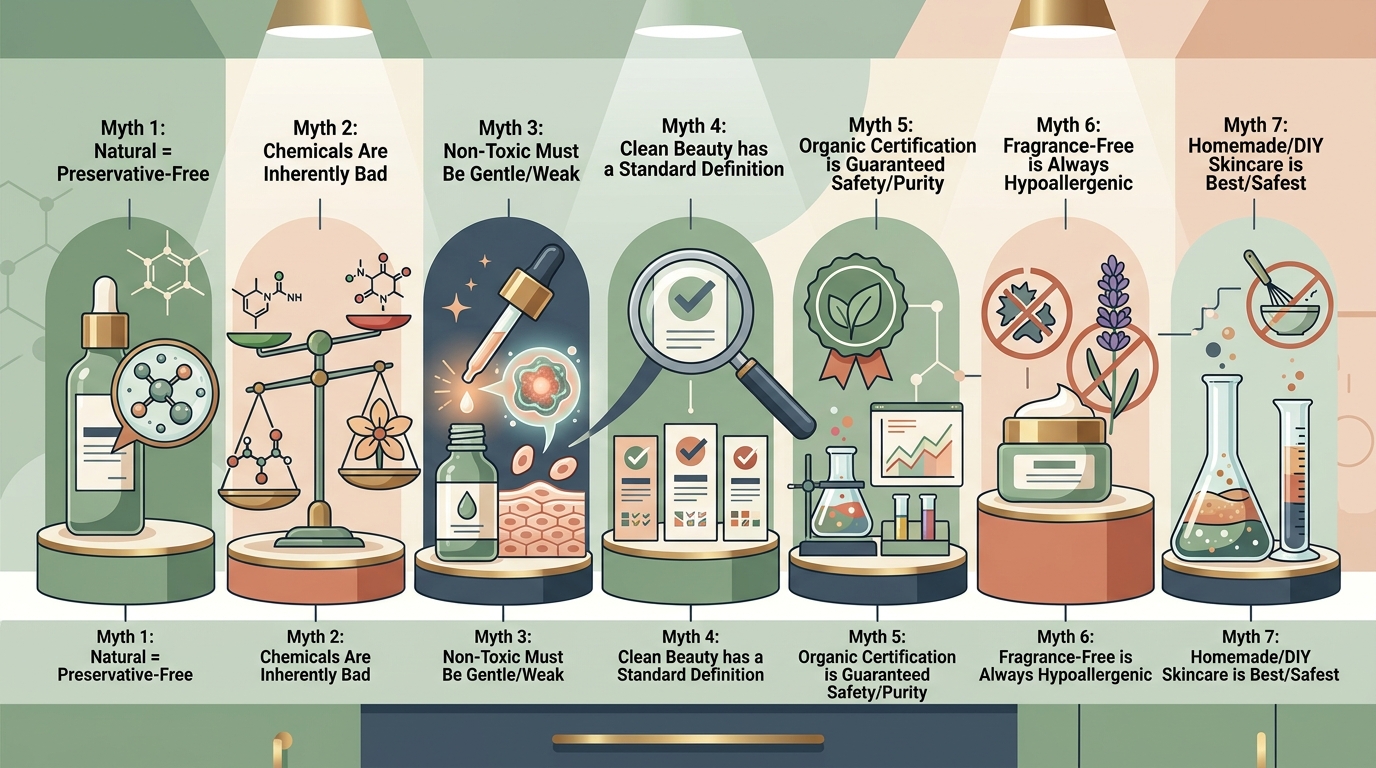
Myth 4: All Synthetic Ingredients Are Bad
The belief that every lab-made ingredient is dangerous does not hold up to scientific scrutiny. Some synthetic ingredients are carefully engineered to be more effective or safer than their natural counterparts. Synthetic hyaluronic acid, for instance, delivers consistent molecular weight for targeted hydration without the batch variability of plant-derived alternatives.
Understanding ingredient function matters more than fearing ingredient origin. Forever Bloom's featured product collection combines biotech-powered actives with naturally derived botanicals for formulas that prioritize results and safety equally.
Myth 5: Non-Toxic Products Are Always Expensive
Price is not a reliable indicator of safety or quality. Many affordable brands now offer well-formulated, non-toxic options. On the flip side, premium products can sometimes justify their price by consolidating multiple steps into one. The Forever Bloom Biomimic® Foundation, for example, replaces primer, color corrector, foundation, and SPF in a single bottle, potentially saving time and money.
Myth 6: Non-Toxic Equals Cruelty-Free
Cruelty-free is a designation indicating that a product and its ingredients were not tested on animals. Many consumers assume that a non-toxic label automatically includes cruelty-free status, but these are two separate claims. A product can be formulated without questionable chemicals yet still involve animal testing. Always look for recognized certifications such as Leaping Bunny or PETA's cruelty-free logo alongside your ingredient evaluation.
Myth 7: Clean Beauty Products Are Less Effective
Early clean beauty products sometimes sacrificed performance for purity, but that era is over. Modern formulation science allows brands to deliver clinical-level results without harsh chemicals. Forever Bloom's Biomimic® technology is a prime example: its patented biomimetic pigments read your skin's undertones in real time, adapting within 30 seconds while delivering SPF 50 and anti-aging benefits. Explore the full science behind the formula to see how innovation and clean ingredients work together.
Quick Comparison: Myths vs. Facts
| Misconception | Reality | What to Do |
|---|---|---|
| Natural is always safer | Natural ingredients can cause allergies and irritation | Evaluate each ingredient individually |
| "Non-toxic" is a regulated term | No legal FDA definition exists | Read full ingredient lists |
| Preservatives are harmful | They prevent dangerous microbial growth | Look for safe preservatives like vitamin E |
| All synthetics are bad | Many synthetics are safer than natural alternatives | Focus on function, not origin |
| Non-toxic means expensive | Multi-use products can reduce overall cost | Calculate cost per use, not sticker price |
| Non-toxic equals cruelty-free | They are separate certifications | Check for Leaping Bunny or PETA logos |
| Clean products underperform | Modern science delivers clinical results cleanly | Try advanced formulas like Biomimic® |
Key Takeaways
- "Natural" does not automatically mean safe; some plant-derived ingredients are potent allergens.
- "Non-toxic" is not a regulated term and should never be your sole purchasing criterion.
- Preservatives protect product integrity and your skin from harmful bacteria.
- Synthetic ingredients can be safer and more effective than their natural equivalents.
- Non-toxic and cruelty-free are separate designations requiring independent verification.
- Clean beauty products can deliver clinical-level results when backed by advanced science such as Biomimic® technology.
- Reading ingredient lists is more reliable than trusting front-of-label marketing claims.
Frequently Asked Questions
What does "non-toxic" actually mean in skincare?
Non-toxic is a marketing term suggesting that a product's ingredients have not been shown to cause adverse health effects at the levels present in the formula. However, no federal agency regulates this claim for personal care products.
Is natural skincare better than synthetic skincare?
Not necessarily. Both natural and synthetic ingredients have safe and unsafe variants. The best approach is to evaluate each ingredient on its own merits and choose products backed by clinical testing.
Are preservatives in skincare safe?
Yes, when used at regulated concentrations. Preservatives prevent microbial contamination that could cause infections or skin reactions. Many non-toxic brands use naturally derived preservatives like tocopherol.
How can I tell if a product is truly non-toxic?
Read the full ingredient list and cross-reference with databases like the EWG Skin Deep tool. Look for third-party certifications and transparent brands that disclose their formulation process.
Does non-toxic skincare work as well as conventional products?
Modern non-toxic formulations can match or exceed conventional products in performance. Technologies like Forever Bloom's Biomimic® system deliver SPF 50 protection and anti-aging benefits in a single step.
Is non-toxic the same as cruelty-free?
No. Non-toxic refers to ingredient safety, while cruelty-free means no animal testing was conducted. Always verify each claim independently through recognized certifications.
Why is "chemical-free" skincare misleading?
Everything, including water, is made of chemicals. The phrase "chemical-free" has no scientific basis and is used purely as marketing language to imply safety.
What should I look for when choosing safe skincare?
Prioritize ingredient transparency, third-party testing, clinical evidence, and brands with a clear scientific mission. Multi-functional products that reduce the total number of formulas you apply can also lower your overall ingredient exposure.
Build Your Non-Toxic Routine with Confidence
Now that you know the facts behind the buzzwords, it is time to choose skincare that truly delivers. Forever Bloom combines Biomimic® technology, SPF 50 protection, and non-toxic formulations in products designed by research scientists. Shop the full collection and experience the difference science-backed skincare makes for your skin.