
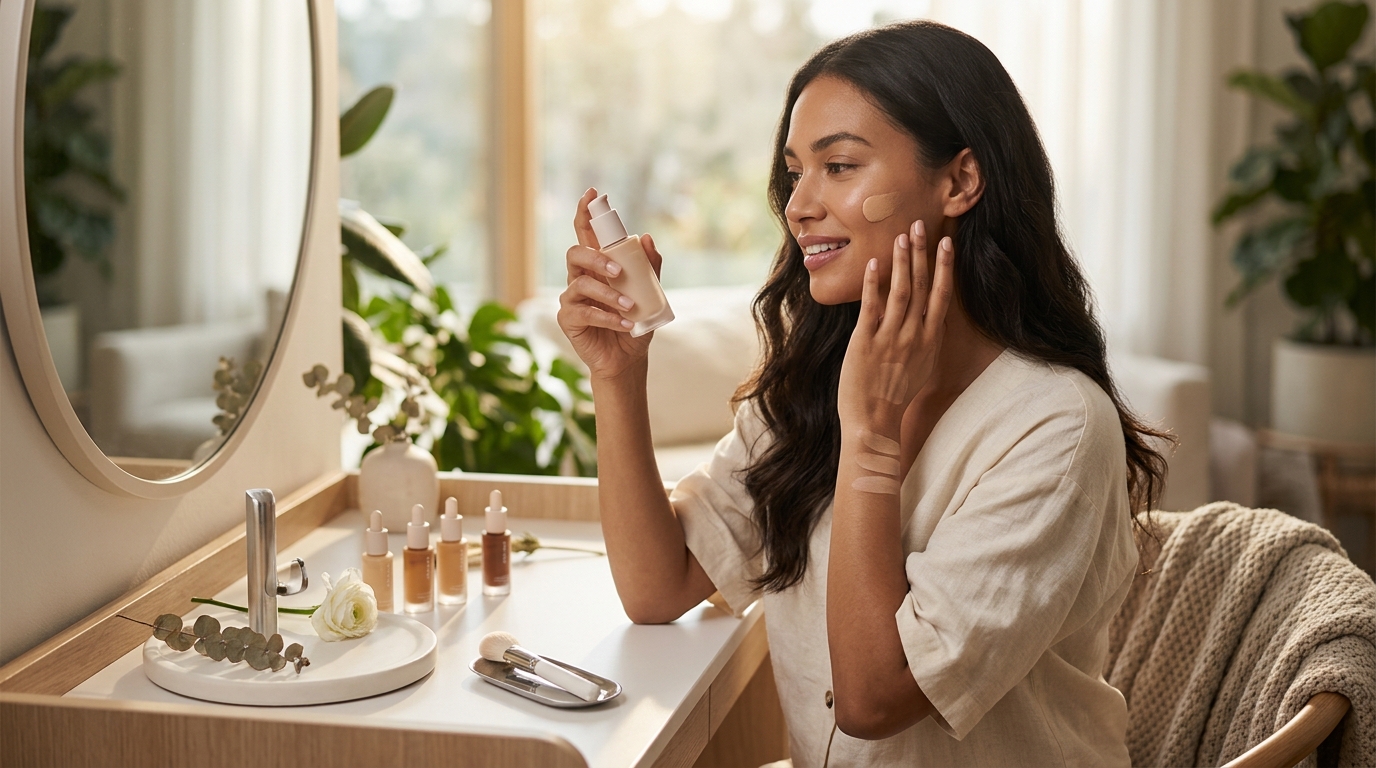
Finding a foundation that truly matches your skin tone can feel like searching for a needle in a haystack. Between confusing shade names, tricky undertones, and colors that oxidize two hours after application, the struggle is real. The good news: once you understand a few key principles, shade matching becomes far simpler. In this guide, we walk you through every step, from identifying your undertone to testing formulas in the right light, and explain how color-adapting technology is changing the game entirely.
Understand Your Skin Tone and Undertone
Skin tone is the overall color depth of your complexion and typically falls into fair, light, medium, or deep categories. Most foundation lines use these labels to organize their shade ranges. However, matching on depth alone is only half the equation.
Undertone is the subtle hue beneath the surface of your skin that influences how any makeup shade appears once applied. Undertones are classified as warm (golden or peachy), cool (pink or blue), or neutral (a blend of both). Getting the undertone wrong is the number-one reason a foundation looks "off," even when the depth is correct, according to L'Oreal Paris.
Quick Tests to Identify Your Undertone
The Vein Test
Check the inside of your wrist in natural light. Blue or purple veins suggest cool undertones; green veins suggest warm. If you see a mix, you likely have a neutral undertone.

The Jewelry Test
Gold jewelry flattering your skin points to warm undertones, while silver looking better suggests cool. If both metals suit you equally, neutral is your match.
The White T-Shirt Test
Hold a white fabric next to your bare face. If your skin looks pinkish, you lean cool. If it looks yellowish or peachy, you lean warm.
How to Swatch Foundation Correctly
Many people swatch foundation on their wrist or jawline, but makeup professionals recommend testing on the center of your face and blending outward. Swatching along the jawline can be misleading because that area sits in shadow.
Apply a thin stripe of two or three candidate shades on your cheek or chin, then step into natural daylight. The shade that disappears into your skin is the right one. Always wear the swatch for a few hours before deciding, because some formulas oxidize and shift color throughout the day.
Why Lighting Makes or Breaks Your Match
A foundation that looks perfect under department-store fluorescents can appear completely different outdoors. Natural daylight is the gold standard for color evaluation because it renders the full spectrum of visible light without a color cast.
Test your match near a window or step outside. If the shade still blends seamlessly from your face to your neck and chest area, you have a winner. A foundation that is the right shade should look consistent in every type of lighting, as Colorescience notes.
Account for Seasonal Skin Changes
Your skin tone is not static. Sun exposure in summer can darken your complexion, while winter months often lighten it. This means many people need at least two foundation shades, or they mix shades to bridge the gap.
Keeping a lighter and a darker bottle on hand works, but it adds cost and complexity. This is one reason color-adapting formulas have surged in popularity: they adjust to your current tone automatically, no seasonal shade-swapping required.
Color-Adapting Foundation: The Modern Shortcut
Color-adapting foundation is a formula that uses intelligent pigments to read your skin and shift to a matching shade upon application. Instead of choosing from dozens of swatches, you select a broad spectrum range and let the technology do the rest.
Forever Bloom's Biomimic Foundation is a leading example. It dispenses as a white formula that analyzes your natural melanin levels and pH, then adapts within 30 seconds to create your perfect shade. The foundation comes in three spectrum ranges: Light Spectrum, Medium Spectrum, and Dark Spectrum, each covering 15+ individual shades within its range.
Beyond shade matching, the formula doubles as SPF 50 sun protection and delivers anti-aging skincare benefits, effectively replacing primer, color corrector, foundation, and sunscreen in one step. Over 400,000 customers have tried it, and the brand backs every purchase with a 100% satisfaction guarantee.
Traditional Foundation vs. Color-Adapting Foundation
| Factor | Traditional Foundation | Color-Adapting (Biomimic) |
|---|---|---|
| Shade selection | Choose from 20-60 fixed shades | One spectrum adapts to 15+ shades |
| Undertone matching | Must identify warm/cool/neutral | Reads undertone automatically |
| Seasonal changes | May need 2+ bottles year-round | Adjusts to current skin tone |
| Oxidation risk | Common with many formulas | Minimal; pigments lock to skin pH |
| Built-in SPF | Varies (SPF 15-30 typical) | Broad-spectrum SPF 50 |
| Application time | Multi-step routine (5-15 min) | Single step, about 30 seconds |
| Average cost per year | Multiple products required | One bottle replaces four products |
Key Takeaways
- Always identify both your skin tone depth and undertone before shopping for foundation.
- Use the vein, jewelry, or white-shirt test to determine warm, cool, or neutral undertones quickly.
- Swatch on your cheek or chin in natural daylight, not on your wrist or jawline.
- Wear a test swatch for several hours to check for oxidation before committing.
- Seasonal skin changes may require you to own multiple shades or switch to a color-adapting formula.
- Color-adapting foundations like Forever Bloom Biomimic Foundation eliminate guesswork by matching your exact tone automatically.
- Look for added benefits such as SPF protection and skincare ingredients to simplify your routine.
Frequently Asked Questions
What is the easiest way to find my foundation shade?
Start by identifying your undertone (warm, cool, or neutral) using the vein test, then swatch candidate shades on the center of your face in natural light. Alternatively, a color-adapting foundation skips manual matching entirely by adjusting its pigments to your skin in real time.
How does color-adapting foundation actually work?
Formulas like Forever Bloom's Biomimic Foundation use nano-encapsulated pigments that slowly release and respond to your skin's melanin and pH. The result is a custom shade match within about 30 seconds of application.
Can one foundation shade really work across all seasons?
With traditional foundations, probably not. Your complexion shifts with sun exposure. However, color-adapting formulas re-calibrate each time you apply, so a single spectrum bottle can work year-round.
Where should I swatch foundation on my face?
Apply a small amount on your cheek or chin and blend outward. Avoid the jawline, which sits in shadow and can give a misleading read on how the shade will appear head-on.
Does foundation with SPF replace my sunscreen?
It depends on the SPF level. Forever Bloom Biomimic Foundation offers broad-spectrum SPF 50 with medical-grade zinc oxide and titanium dioxide, which meets the protection level dermatologists recommend for daily use.
What if my face and neck are different colors?
Match your foundation to your neck and chest to avoid a visible contrast line. A color-adapting foundation helps here because it reads the skin it touches, blending more naturally at borders.
Is color-adapting foundation safe for sensitive skin?
Forever Bloom's formula is dermatologist-tested, fragrance-free, and hypoallergenic, making it suitable for sensitive, acne-prone, and mature skin types.
How long does it take to apply a color-adapting foundation?
About 30 seconds. Apply over moisturizer, rub in a circular motion, and the shade locks in almost immediately, saving the average user over 12 minutes each morning compared to a multi-step routine.
Find Your Perfect Match Today
Tired of shade-matching disasters? Try Forever Bloom Biomimic Foundation and let the formula do the matching for you. With SPF 50, anti-aging skincare, and a 100% money-back guarantee, there is zero risk and a whole lot of glow to gain.