

Finding a foundation that truly matches your skin tone is one of the most common beauty challenges. Between confusing shade names, bad store lighting, and the dreaded jawline contrast line, it is easy to end up with a bottle that looks nothing like your complexion once you step outside. The good news? Once you understand your skin tone depth, undertone, and the role that formula technology plays, shade matching becomes far simpler. This guide walks you through every step, from identifying your undertone to discovering color-adapting foundations that do the matching for you.
Step 1: Understand Your Skin Tone Depth
Skin tone depth is the overall lightness or darkness of your complexion. It typically falls into four main groups: fair, light, medium, and deep. Examining your bare, clean face in natural daylight is the fastest way to determine where you land on that spectrum.
Most foundation ranges organize their shades around these depth categories, so knowing yours immediately narrows the field. If you shop online, look for brands that label their products clearly, such as Forever Bloom's Light Spectrum, Medium Spectrum, or Dark Spectrum foundations.
Step 2: Identify Your Undertone
Your undertone is the subtle color beneath the surface of your skin that influences how any makeup shade appears once applied. Undertones fall into three categories: cool (pink or blue hues), warm (yellow or golden hues), and neutral (a balanced mix of both).
The Vein Test
Turn your wrist over in natural light and check your vein color. Blue or purple veins generally indicate cool undertones, green veins suggest warm, and a mixture points to neutral. This simple check, recommended by L'Oreal Paris, takes seconds and provides a reliable baseline.
The Jewelry Test
If silver jewelry flatters you more than gold, you likely lean cool. Gold looking better suggests warm undertones. People who look equally good in both are usually neutral. Choosing a foundation that aligns with your undertone prevents the orange, ashy, or overly pink cast that plagues a bad match.
Step 3: How to Test Foundation Shades
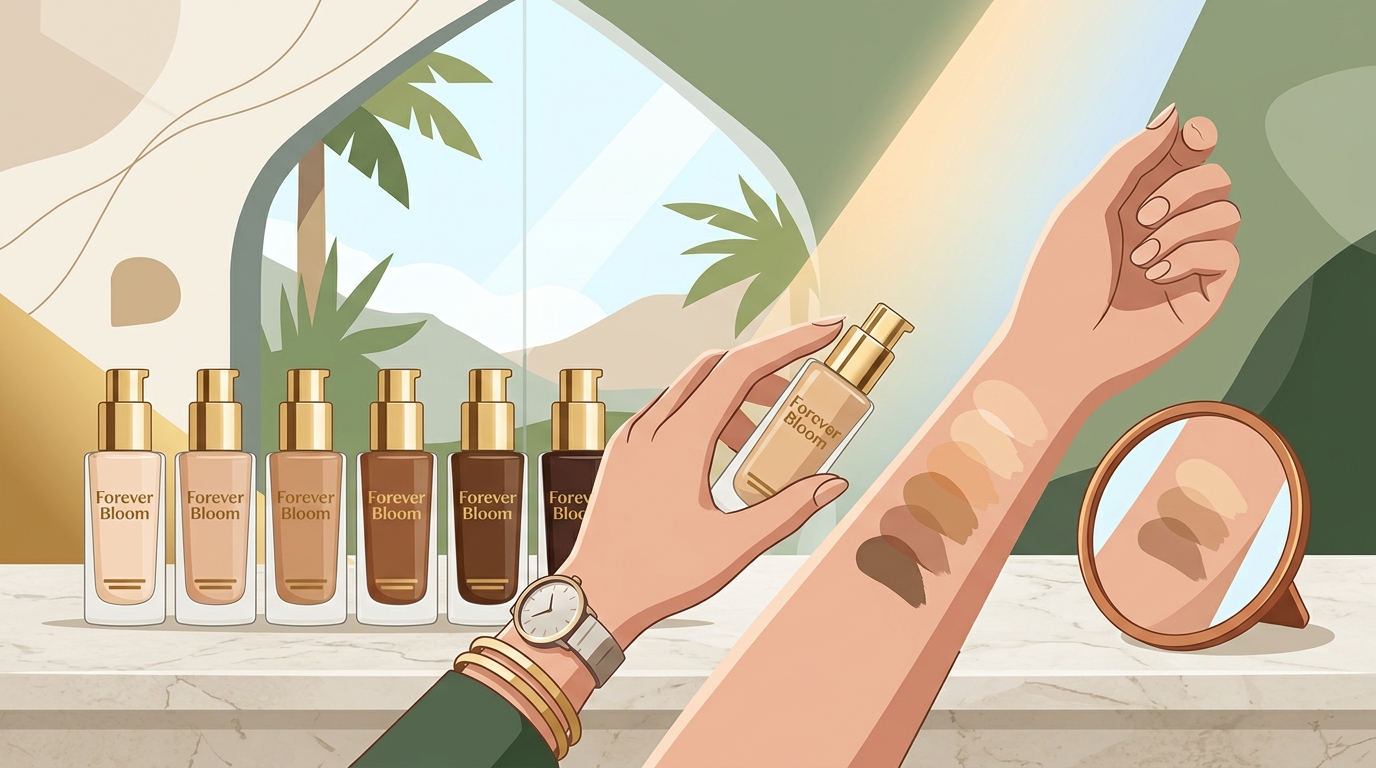
Swatching is the process of applying small streaks of foundation on your skin to compare shades side by side. Many beauty experts recommend swatching on the center of your face or cheek rather than the jawline, because the jaw sits in shadow and can skew your perception of the color.
Check in Multiple Lighting Conditions
A foundation that looks perfect under fluorescent store lights may appear completely different in daylight. Always step outside or near a window before making a final decision. If the shade disappears into your skin and matches your neck seamlessly, you have a winner.
Wear-Test Before You Commit
Ask for a sample or purchase from a brand with a satisfaction guarantee. Wear the foundation for a full day to see how it oxidizes and interacts with your natural oils. Forever Bloom, for example, backs every order with a 100% satisfaction guarantee and free exchanges within 30 days.
Step 4: Account for Seasonal Skin Changes
Your complexion is not static. Summer sun exposure can darken your skin by one or two shade levels, while winter often lightens it. Many people end up owning multiple foundation bottles to cover seasonal shifts, which is both expensive and wasteful.
Makeup artist Bobbi Brown recommends keeping a deeper shade on hand and mixing it with your regular shade when your tan changes. Alternatively, choosing a formula with color-adapting technology can eliminate the need for multiple bottles entirely.
Step 5: Consider Color-Adapting Foundation Technology
Color-adapting foundation is a category of makeup that uses intelligent pigments to read your skin's melanin levels and adjust its shade automatically. Unlike traditional fixed-shade formulas, these products start as a neutral base and transform upon contact with your skin.
Forever Bloom's Biomimic Foundation uses patented biomimetic technology with nano-encapsulated pigments that slowly release to match the skin's surface. The formula starts white, then adapts within 30 seconds to create a personalized shade. It also packs SPF 50 broad-spectrum sun protection, anti-aging ingredients, and a lightweight, non-comedogenic formula into one step, effectively replacing primer, color corrector, foundation, and sunscreen.
With three spectrum ranges (Light, Medium, and Deep) each covering 15+ shade variations, the technology works across a wide variety of skin tones, including tricky olive and neutral undertones that traditional shade charts often miss.
Traditional Foundations vs. Color-Adapting Foundations
| Feature | Traditional Foundation | Color-Adapting (e.g., Biomimic) |
|---|---|---|
| Shade selection | Must choose exact shade from 20-50 options | One spectrum adapts across 15+ shades |
| Undertone matching | Requires knowing cool/warm/neutral | Reads undertone automatically |
| Seasonal adjustments | May need 2-3 bottles per year | Single bottle adapts year-round |
| SPF protection | Usually separate product needed | Built-in SPF 50 |
| Application time | 10-15 minutes (with primer, SPF layers) | About 30 seconds |
| Oxidation risk | Common with certain formulas | Designed to resist oxidation |
Key Takeaways
- Determine your skin tone depth (fair, light, medium, deep) before shopping for any foundation.
- Identify your undertone using the vein test or jewelry test to avoid mismatched shades.
- Swatch on the center of your face, not the jawline, and check color in natural daylight.
- Wear-test a foundation for a full day to observe oxidation and oil interaction.
- Account for seasonal skin tone changes so you are not stuck with the wrong shade in summer or winter.
- Color-adapting foundations like Forever Bloom's Biomimic line eliminate shade-guessing by reading your skin and adjusting automatically.
- Look for multi-benefit formulas that combine SPF, skincare, and coverage to simplify your routine.
Frequently Asked Questions
What is the easiest way to find my foundation shade online?
Start by identifying your skin tone depth and undertone using the vein test. Then look for brands that organize shades by spectrum or offer color-adapting technology so you do not have to guess between dozens of numbered shades.
How do I know if my foundation matches my skin tone?
Apply it to your face and check in natural light. The right shade should blend invisibly from your face down to your neck with no visible contrast line at the jawline.
Why does my foundation look different after a few hours?
Oxidation is the chemical reaction between a foundation's pigments and the oils and air on your skin, causing it to darken or turn orange over time. Formulas designed to resist oxidation, such as biomimetic foundations, are less prone to this color shift.
Do I need different foundation shades for summer and winter?
Many people do, because sun exposure darkens the skin in warmer months. Color-adapting foundations can adjust automatically, potentially saving you from buying multiple bottles each year.
What is color-adapting foundation?
Color-adapting foundation is a makeup formula containing intelligent pigments that analyze your skin's natural melanin and pH levels, then shift color to match your unique tone upon application.
Is Forever Bloom's Biomimic Foundation good for sensitive skin?
Yes. The formula is dermatologist-tested, fragrance-free, and hypoallergenic, and it uses a non-comedogenic base that will not clog pores or irritate reactive skin types.
How long does a color-adapting foundation take to match my skin?
Forever Bloom's Biomimic Foundation typically adapts within 30 seconds of blending. You apply the white formula to clean skin and rub in a circular motion until the color transformation is complete.
Can one foundation really replace primer, sunscreen, and color corrector?
Multi-benefit formulas exist that combine broad-spectrum SPF, color-correcting pigments, hydrating skincare ingredients, and buildable coverage in a single step. Forever Bloom's 4-in-1 Biomimic Foundation is one example designed to do exactly that.
Ready to Skip the Shade-Matching Guesswork?
Experience a foundation that reads your skin and matches it automatically. Try Forever Bloom's Biomimic Foundation risk-free with a 100% satisfaction guarantee.