

Finding a foundation that truly matches your skin tone is one of the most common beauty challenges. Between confusing shade names, tricky undertones, and colors that oxidize after an hour, it can feel like you need a chemistry degree just to buy makeup. The good news? Modern techniques and new technologies have made shade matching far more reliable. In this guide, you will learn how to identify your skin tone and undertone, test shades correctly, and discover color-adapting formulas that remove the guesswork entirely.
Understand Your Skin Tone vs. Undertone
Before you swatch a single product, you need to understand two distinct concepts. Skin tone is the overall color depth of your complexion and typically falls into fair, light, medium, or deep categories. Undertone is the subtle hue beneath the surface of your skin that influences how any makeup shade appears once applied.
Many people match their surface tone correctly but ignore undertone, which is exactly where things go wrong. A foundation that clashes with your undertone will look unnatural, often leaving a visible contrast line along the jawline or neck. Getting both right is the foundation of flawless foundation (pun intended).
How to Determine Your Undertone
The Vein Test
Check the inside of your wrist in natural light. Blue or purple veins suggest cool undertones, green veins suggest warm undertones, and a mix of both points to neutral undertones. This quick check, recommended by L'Oréal Paris, is one of the most reliable at-home methods.
The Jewelry Test
If gold jewelry flatters your skin more than silver, you likely have warm undertones. Silver looking better indicates cool undertones. If both metals work equally well, you are probably neutral.
The Sun Exposure Test
People who burn easily and have pinkish skin typically lean cool, while those who tan quickly and have a golden cast tend to be warm. Neutral undertones fall somewhere in between.
Test Shades the Right Way
Where you swatch matters. Apply test shades toward the center of your face and blend outward rather than along the jawline, which is often shadowed and gives misleading results. Always compare the shade against your neck and chest area to avoid that dreaded line where makeup ends and bare skin begins.
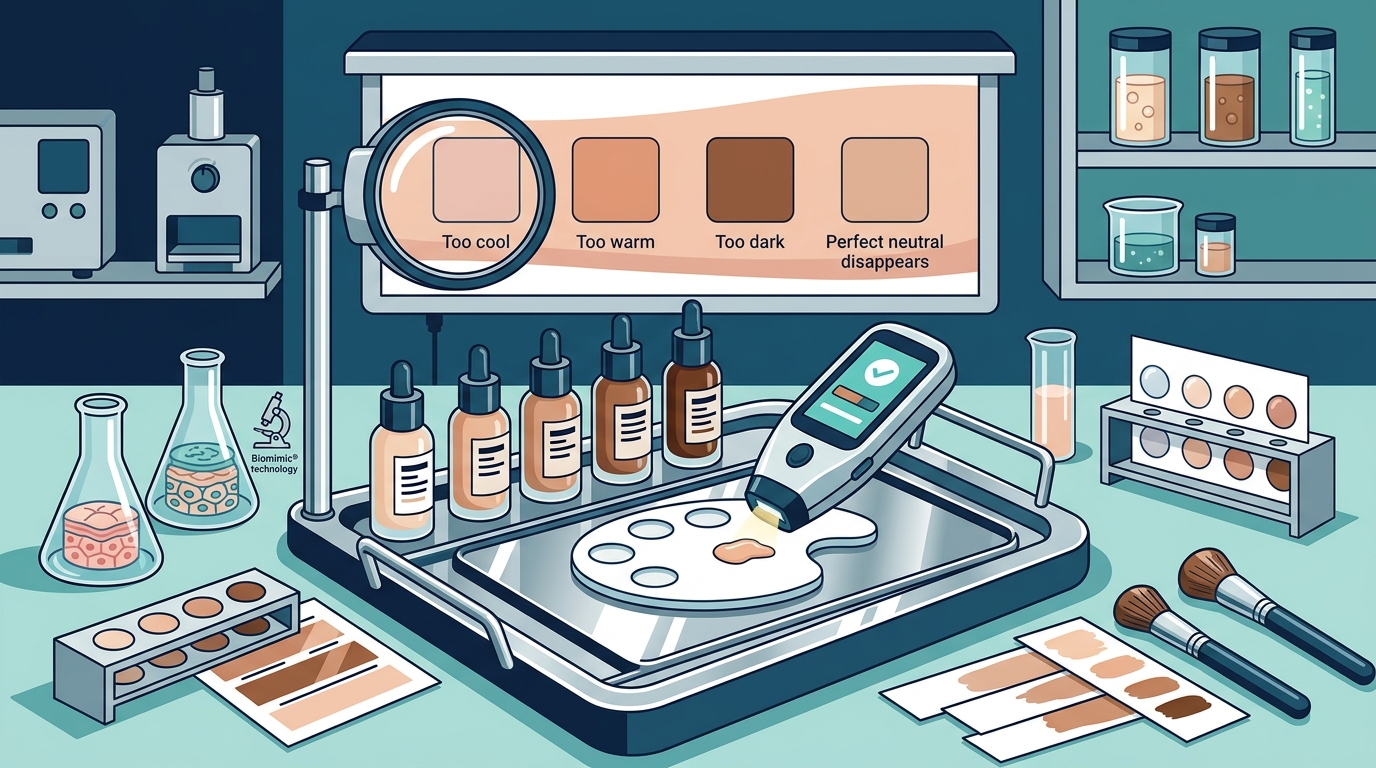
Check your match under multiple lighting conditions. A shade that looks perfect in fluorescent store lighting can appear completely different in daylight. If the foundation seems to disappear into your skin in both natural and indoor light, you have found your match.
| Factor | Traditional Foundation | Color-Adapting Foundation |
|---|---|---|
| Shade Selection | Choose from 20-50 fixed shades | One spectrum adapts across 15+ shades |
| Undertone Matching | Must identify undertone first | Reads undertone automatically |
| Seasonal Adjustments | May need 2-3 bottles year-round | Single bottle adapts to tan changes |
| Oxidation Risk | Color can shift after application | Designed to resist oxidation |
| Time to Match | Trial and error over days or weeks | Adapts within 30 seconds |
Account for Seasonal Skin Changes
Your skin tone is not static. Increased sun exposure in summer can darken your complexion by one or two shades, while winter months often bring a lighter, more neutral tone. This means a single fixed-shade foundation may only be accurate for part of the year.
Some beauty experts recommend purchasing two shades and mixing them as seasons transition. A simpler alternative is to use a foundation with color-adapting technology that adjusts automatically as your skin shifts throughout the year.
Why Color-Adapting Foundations Change the Game
Color-adapting foundation is a formula that reads your skin's natural melanin and pH levels, then adjusts its pigment to match your exact tone. Instead of choosing from dozens of fixed shades, you pick a broad spectrum (light, medium, or deep), and the formula does the rest.
Forever Bloom's Biomimic Foundation uses nano-encapsulated pigments that slowly release and adapt to your skin's unique surface. The formula starts white, then transforms within seconds to create a seamless match. It is available in three spectrum ranges: Light Spectrum for fair to light tones, Medium Spectrum for medium complexions, and Dark Spectrum for deeper skin tones.
This approach eliminates the most common shade-matching pain points: oxidation, wrong undertones, and needing multiple bottles for seasonal changes. The formula also includes broad-spectrum SPF 50, replacing a separate sunscreen step in your routine.
Choose the Right Formula for Your Skin Type
Dry or Mature Skin
Look for hydrating, serum-style foundations that will not settle into fine lines. A lightweight, moisturizing formula with ingredients like hyaluronic acid works best. Pairing your foundation with a nourishing base like a Vitamin C cream can boost radiance further.
Oily or Combination Skin
Oil can dilute pigments and cause color shift throughout the day. Opt for non-comedogenic, long-wear formulas that resist breakdown. Sweat-proof options are especially helpful for active lifestyles.
Sensitive Skin
Fragrance-free, hypoallergenic, and dermatologist-tested formulas reduce the risk of irritation. Always patch-test a new foundation before committing to full-face application.
Key Takeaways
- Skin tone is the depth of your complexion; undertone is the subtle warm, cool, or neutral hue beneath it. Both matter for shade matching.
- Use the vein test, jewelry test, or sun-reaction test to determine your undertone at home.
- Swatch foundations on the center of your face, not the jawline, and check in multiple lighting conditions.
- Your skin tone changes with the seasons, so one fixed shade rarely works year-round.
- Color-adapting foundations use intelligent pigments to read your skin and create a custom match in seconds.
- Always match your foundation to your neck and chest to avoid visible contrast lines.
- Choose a formula that suits your skin type: hydrating for dry skin, long-wear for oily skin, and hypoallergenic for sensitive skin.
Frequently Asked Questions
What is the easiest way to find my foundation shade online?
Start by identifying your skin tone depth (fair, light, medium, deep) and your undertone (warm, cool, neutral). Many brands offer virtual try-on tools or shade-finder quizzes. Alternatively, a color-adapting foundation removes the guesswork by adjusting to your skin automatically.
How do I know if my foundation matches my undertone?
Apply the foundation and check in natural daylight. If the shade blends seamlessly without looking too pink, too yellow, or too ashy, the undertone is correct. A mismatch usually shows up as a visible line at the jawline.
Can one foundation really work for all skin tones?
No single product matches every skin tone, but color-adapting foundations cover a much wider range than traditional fixed shades. For example, each Forever Bloom Biomimic spectrum adapts across 15+ shades within its range.
Why does my foundation look different after a few hours?
This is called oxidation. Your skin's oils and pH react with the foundation's pigments, causing the color to darken or shift. Formulas designed to resist oxidation, such as those using encapsulated pigments, help prevent this problem.
Should I match foundation to my face or my neck?
Match to your neck and chest for the most natural result. Many people's faces are slightly darker than their neck due to sun exposure, so matching to the face alone can create an uneven appearance below the jawline.
How often should I re-evaluate my foundation shade?
At minimum, reassess at the start of summer and winter when your skin tone is most likely to shift. If you use a color-adapting formula, it adjusts to these changes automatically.
What is Biomimic technology in foundation?
Biomimic technology is a formulation approach that uses nano-encapsulated pigments to read your skin's melanin levels and pH, then slowly release color to match your unique tone. It is the science behind Forever Bloom's color-adapting foundation line.
Is SPF in foundation enough sun protection?
A foundation with broad-spectrum SPF 50 can provide meaningful daily protection when applied generously. However, for extended outdoor exposure, dermatologists generally recommend supplementing with a dedicated sunscreen.
Find Your Perfect Match Today
Tired of shade-matching disasters? Explore the Forever Bloom Biomimic Foundation collection and experience a formula that adapts to your exact skin tone in seconds, with built-in SPF 50 and skincare benefits. Shop risk-free with a 100% satisfaction guarantee.